Let’s face it: London is one of the greatest cultural cities in the world. During this month I have found very difficult to focus my attention on its musical facet as there are millions of stimuli showing up around you.
One of the best attractions are the National Museums of the UK that one can visit for free. The Science Museum was founded together with the V&A and The Natural History Museum after The Great Exhibition, the first International Wold Fair in 1851. This exhibition was an unprecedented way to show to the public the various cultural and industrial achievements of the British Empire. Nowadays, these museums are an immense source of knowledge and a big entertainment for kids and grown ups, specially in typical rainy days.
I got attracted for the Cosmonauts exhibition the first time I saw the add (I have always been attracted to soviet propaganda aesthetics).
Everybody knows that the Space Race competition for the technical dominance between the US and the URSS was crucial in the Cold War and that US ‘won’ the competition when they landed first in the moon. You also know that an Astronaut is a a person engaged in or trained for spaceflight. What some of you may not know is that a Cosmonaut is the soviet word for astronaut.
At this point is where the remark comes: Do we really know the soviet features in the Space Race? what was the hidden face of this crazy Star Wars?. The exhibition provides a really interesting chronology of facts and discoveries promoted on the URSS as well as a realistic viewpoint of Cosmonauts’ training and life.
In the beginning, there were a group of geeky astronomy visionaries that started designing futuristic spaceships (comparable to Wozniak and Jobs building computers in their Garage). Then, the Space Race begun and the Soviets led the run until almost the end. This was possible thanks to the former Gulag prisoner Sergei Koroliov, ‘The Chief Designer’. He was responsible for the launching of the Sputnik , the first artificial satellite. He also was behind the project that put the first dog (Laika), man (Yuri Gagarin), woman (Valentina Tereshkova), and first man to walk (Alexei Leonov) in space. Finally, by landing on the moon, the United States effectively “won” the space race that had begun with Sputnik’s launch.
The spectacularity of the exhibition comes with the showing of a model of The Sputnik (that means fellow traveller), a Voskhod (‘smile’) descending module, and a Soyuz (‘union’) spaceship. Remarkably, Soyuz spaceships are the most frequently used and most reliable launch vehicle in the world to date.
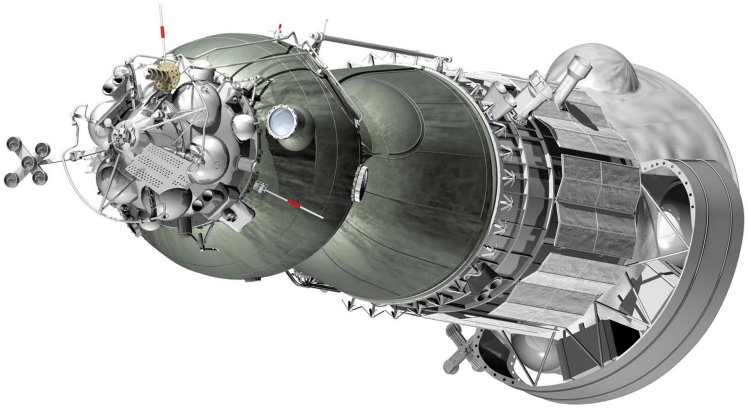
The incredible amount of budget spent from the nations involved, the numbers of human resources invested are countless. Today, astronauts from everywhere in the world fly to the International Space Station in a Soyuz after the cancellation of the space shuttle program. Pilots are specifically trained in Russia and are taught Cyrillic to make sure astronauts can play all the buttons. So in the end…who won the Space Race?
 Stereo Giraffe